In performance and video art, sound often stops being a supporting player and becomes the work itself: a primary medium that builds a sonic world the audience inhabits rather than merely accompanies a story. The conceptual dividing line is straightforward once named. Conventional film sound design—dialogue, effects, music, and mixing—exists to enrich a narrative and guide the viewer's emotions toward it. In much contemporary performance practice, sound instead creates an atmosphere and an environment, one that may not correspond to anything visible and that the audience experiences bodily. The distinction matters because it changes how you watch, listen, and judge what a work is doing.
Performance and Video Art: Sound as a Primary Medium
The traditional arrangement is familiar from cinema, where sound design is understood as the art of enriching an audiovisual work: effects and foley ground the image, dialogue carries plot, music tells you how a scene should feel. The viewer is typically a passive observer guided by the narrative, with sounds located within the scene or serving as background. This model dominates not only film but also television and advertising, and it is the default vocabulary most audiences bring to any work with a soundtrack.
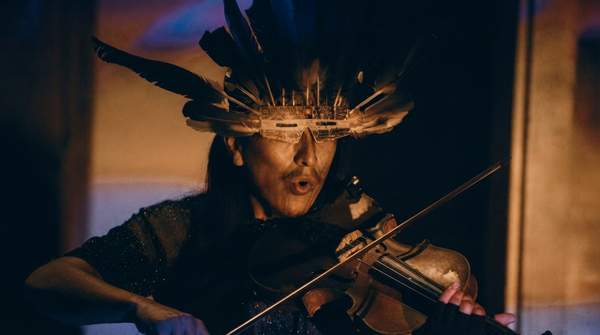
Contemporary performing arts have been pulling away from that model. Writing in Critical Stages, a scholar of sonic practice argues that new technologies for sound production have opened "an exuberant and overwhelming array of new artistic possibilities for sound design and music in live and digital performances" over the past few decades. The key point is not the equipment itself but the shift in status it enables: sound stops being an ornament to a scene and becomes one of the materials from which the scene is made. Immersive and spatialization technologies, in this account, suggest "a fluid understanding of sonic practices in contemporary performing arts, defying traditional boundaries of genres."
That fluidity is what makes the fine-art context distinct. Where a film soundtrack is evaluated by how well it serves the picture, sound in performance and video art can be evaluated as an artistic proposition in its own right—something that proposes a world, an encounter, or a transformation. The same author concludes that understanding these creative possibilities helps practitioners move "beyond preconceived and narrow notions of sound design and musical composition," and that a rethinking of sonic practices is needed to unlock the technologies' artistic potential. For the viewer, the parallel move is to stop treating sound as automatic accompaniment and start asking what it is doing.
Key Concepts: Immersive Sound and Atmospheric Transformation
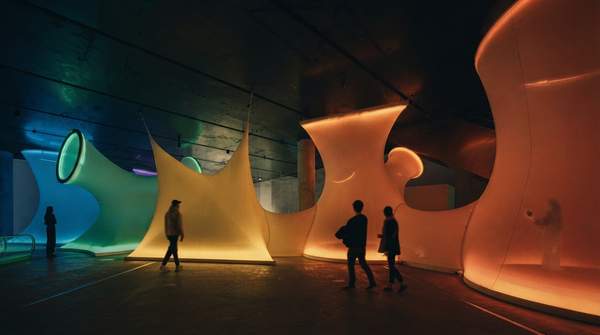
Two ideas carry most of the analytical weight. The first is immersive sound: sound that surrounds the listener rather than arriving from a single, clearly located source. Immersion is closely tied to spatialization, the distribution and movement of sound through a space, which turns listening from a front-facing activity into an environmental one. Instead of pointing at a source on a screen, the listener is enveloped by a field whose boundaries are the room itself. This is the mechanism behind the shift from passive listening to an active, embodied participant role: the audience is inside the work's sonic conditions rather than outside them.
The second idea is atmospheric transformation. Drawing on the scenographer Maaike Hahn's phrase "a feeling of the beyond," the Critical Stages author describes how the crafting of a scene—through the orienting qualities of light and sound alongside costume and scenery—encompasses "a range of distinct methods for atmospheric transformation that score how encounters of 'world' are conceptualized and rendered attentive." In plainer terms: sound does not decorate a pre-existing atmosphere; it actively scores how the world of the piece is built and how the audience's attention is organized within it.
Atmospheric transformation is closely associated with electroacoustic practice, where voices, objects, and soundscapes are treated as raw material to be reshaped rather than reproduced. The result can be abstract and spatialized sound that defies a clear source, forming a distinct sonic world that may not directly correspond to the visuals. That non-correspondence is a feature, not a failure: it is often precisely where the artistic concept lives.
Framework for Analyzing Sound in Art
Use the following matrix when you encounter a piece of performance or video art. Evaluate the work along two dimensions—Primary Function and Nature of Sound—and read the resulting classification as a judgment about the artist's sonic strategy.
| Dimension | If you observe this… | Classification |
|---|---|---|
| Primary Function | Sound tells you how to feel about the visuals and reinforces the narrative; remove it and the story still reads. | Traditional narrative support (cinematic model) |
| Primary Function | Sound creates a world to experience—an atmosphere or sonic environment that is itself the artistic proposition. | Primary, world-building medium |
| Nature of Sound | Sound is clearly located within the scene (diegetic) or serves as background; sources are identifiable. | Conventional cinematic technique |
| Nature of Sound | Sound is abstract, spatialized, and enveloping; it surrounds you and defies a clear source, transforming voices, objects, and soundscapes. | Expanded performance-art practice |
The reasoning path is cumulative. A work whose sound merely reinforces narrative and stays diegetic sits firmly in the cinematic tradition. A work whose sound builds an enveloping, source-defying environment is operating in the expanded register the Critical Stages author describes, where sonic practices defy traditional genre boundaries. Many works mix both registers—using conventional support in one passage and atmospheric world-building in another—so classify passage by passage, not the whole work at once. The decisive test question is whether the artwork's meaning fundamentally changes or collapses if the sound is removed or altered.
Appreciating Sound's Evolved Role
When encountering performance or video art, actively analyze sound as a potentially independent artistic medium, rather than solely as a narrative support. The framework above gives you the vocabulary: ask whether the sound is telling you how to feel or building a world to inhabit, and whether it stays within the scene or surrounds you as spatialized, transformed material. The measurable indicator is simple and testable in the gallery or the theater: the artwork's meaning or impact is significantly altered or diminished if the sound component is removed or changed, indicating its primary role. If silencing the piece would leave the visuals to carry the meaning intact, the sound was support; if silencing it would dissolve the world the work proposes, the sound was the art.
Sources
- Expanding Sound Design in Performing Arts — Critical STAGES