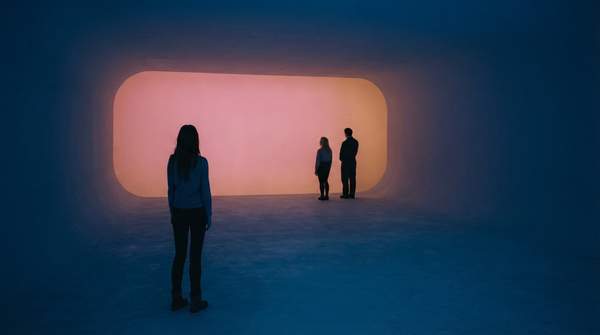
Contemporary light art falls into three broad technical families: sculpting with manufactured light sources such as fluorescent tubes and neon, projecting digital and data-driven imagery onto surfaces, and manipulating light and shadow to reshape perception. Each approach has a recognizable pioneer—Dan Flavin for the fluorescent tube, Refik Anadol for the AI-driven projection, James Turrell for perceptual manipulation—and each pursues the same underlying goal: to make light the primary medium rather than a means of illuminating something else.
The Evolution of Light as Art
For most of art history, light was a servant of representation. Painters used it to model form and drama, but the light lived inside the picture, not in front of the viewer. That hierarchy inverted during the 20th century, when, as the art magazine Atmosfera recounts, art moved beyond mere representation of reality—displaced by photography and the languages of the avant-gardes—and light "emerged as an independent expressive medium." By the 1960s, the magazine's writer Pietro Leonardi notes, light had become "a true medium, tied to conceptual and minimalist art movements."
The shift was radical because it redefined what counted as art material. Dan Flavin, working from the early 1960s, insisted on commercial fluorescent tubing as a stand-alone medium—a direct challenge, as Artsy's editorial history of the field puts it, to traditional perceptions of which materials were worthy of art. His glowing, hard-lined sculptures grew increasingly complex over time, eventually evolving into fully immersive light environments. Crucially, Flavin's concern extended beyond the tubes themselves to the space around them: he structured how viewers experienced and moved through interiors, making architecture itself part of the work.
Sculpting with Manufactured Light
The first technique treats light fixtures as physical sculpture. Flavin is considered the master of this mode; Atmosfera records that in 1963 he created his first work with fluorescent lamps, naming it and subsequent works Icons. The tubes are readymade hardware, but their glow, color, and placement transform walls and corners into compositions that have volume and presence without any traditional sculptural mass.
Keith Sonnier took the same industrial material in a different direction. His neon works, Artsy explains, brought "a softer, more figurative effect, referencing the natural world in compositions of bent and curved tubes of light"—a deliberate contrast with Flavin's rigid, hard-lined forms. Where Flavin's fluorescents emphasize geometry and architectural space, Sonnier's bent neon curves toward gesture and image. The lighting-industry publication Alcon Lighting frames the broader field similarly: artists use "light color, intensity, filters, angles and shadows" as their working materials, and neon signs and light sculptures are more widespread in museums and public spaces than many viewers realize.
Digital and Data-Driven Light Installations
The second technique replaces the fixed tube with projected, algorithmically generated light. Alcon Lighting identifies projection mapping as the newest major trend: video projected onto an object or wall uses color, light, and movement to give a static three-dimensional surface the appearance of transformation into something almost lifelike. The projection is not an image of something else—it is the artwork's substance.
Refik Anadol has pushed this category furthest by feeding data into the projection pipeline. TIME, in awarding him an Impact Award, describes how he uses AI to discern patterns from vast datasets, pioneering forms he calls AI data paintings and data sculptures, co-created with the AI systems processing the data to produce "constantly-evolving audiovisual experiences." His project Archive Dreaming, developed during a residency at SALT Galata, turned the gallery into what his studio calls an all-encompassing environment in which "a temporary immersive architectural space is created as a canvas with light and data applied as materials." Anadol's team has produced more than 50 such works over the past decade, and he deliberately displays the names of the AI, the algorithm, and the data used—part of his stated position that the systems, not only the artist, deserve credit.
Manipulating Light, Shadow, and Perception
The third technique works at the opposite end of the spectrum: not adding light but shaping its absence and behavior. Tate's coursework guide for students traces this perceptual lineage through Op Art, the 1960s movement in which artists experimented with geometric forms to create optical effects, and through painters like Gillian Carnegie, whose Black Square (2008) combines matt and glossy black paint so that tree trunks and branches emerge only as the viewer moves and light catches the ridges of brushstrokes. The image exists in the interaction between illumination, surface, and the moving spectator.
James Turrell carries this perceptual logic into full installation scale. Artsy notes that his background in perceptual psychology informs work exploring light as an object that has volume, and perception itself as an artistic medium. In 1984, Turrell and Robert Irwin each received MacArthur awards in three-dimensional visual art; Irwin helped initiate the Light and Space Movement, envisioning light-based art that acclimated to its location and heightened viewers' understanding of the environment around it. The artistic goal here is not spectacle but recalibration—making the viewer notice their own act of seeing.
Key Techniques in Contemporary Light Art
The three approaches can be sorted by the physical medium or technology each employs—manufactured tubes, projected digital light, or manipulated shadow and perception—which is what distinguishes, say, a neon sculpture from a projection-mapped facade.
| Technique | Key Characteristic | Exemplary Artist(s) |
|---|---|---|
| Manufactured light sources | Industrial fluorescent tubes and neon used as tangible sculptural material, emphasizing light's physical presence, color, and effect on architecture | Dan Flavin (rigid fluorescent forms); Keith Sonnier (bent, curved neon referencing the natural world) |
| Projection and digital tools | Video and algorithmically generated light projected onto surfaces and spaces, often driven by datasets, producing evolving audiovisual environments | Refik Anadol (AI data paintings and sculptures, projection mapping) |
| Manipulating light, shadow, and perception | Subtle control of illumination, surface, and shadow to create illusions and make perception itself the subject | James Turrell (perceptual psychology, light as volumetric object); Robert Irwin (Light and Space Movement) |
Reading the table row by row reveals the field's logic: each category answers the same question—what is the artwork made of?—with a different material answer, and each artist's fame rests on having defined that answer for a generation of successors.
Creating Immersive Environments
What unites the three techniques is their drift away from the discrete object toward the enveloping environment. Flavin's sculptures evolved into immersive light environments that structured how viewers moved through space. Anadol's installations go further still: MyArtBroker describes his data-driven work as using algorithms to create dream-like environments merging art, science, and technology, while his own studio describes Archive Dreaming as an all-encompassing environment intertwining history with the contemporary. In both cases the viewer does not look at the work so much as stand inside it.
This envelopment is the perceptual payoff of light as a medium. Because light has no fixed edges and fills whatever volume contains it, a light installation can dissolve the boundary between artwork and room, and between observer and participant. Atmosfera captures the conceptual ambition in describing one pioneer's aim: "light transcends mere illumination and becomes energy, a sensitive element interacting with materials." The viewer's altered sense of space—walls that seem to recede, surfaces that appear to breathe—is not a side effect but the artistic goal.
Recognizing Light as a Primary Artistic Medium
To fully appreciate contemporary light art, viewers should identify the specific light technique used, understand the artist's conceptual goals, and recognize how the work alters their perception of space. The test is simple: the reader can articulate the technique, artist, and immersive effect of a given light art installation. Standing before a glowing work, ask whether the light is manufactured and sculptural, projected and data-driven, or perceptually manipulated—and whether the piece is an object you view or an environment you inhabit. Answering those questions converts a passing encounter with light into a genuine reading of the medium.