Film festival juries rarely hand prizes to the films with the cleanest sound design; they hand prizes to the films they cannot stop discussing. According to the organizers and jurors who actually run these competitions, evaluation happens on two connected levels: a working assessment of technical craft, and then a decisive, subjective judgment about a film's emotional and intellectual impact. Understanding that two-step structure explains one of the festival world's most common frustrations for audiences — why a technically immaculate film can walk away empty-handed while a rougher, more resonant one takes the prize.
Understanding Film Festival Juries: Composition and Purpose
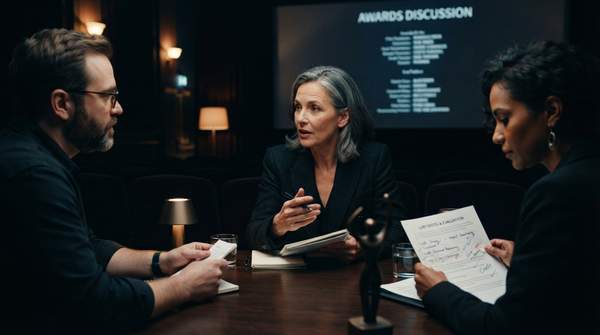
Festival juries are small deliberative bodies, and festivals deliberately build them out of complementary professional perspectives. Mitch Davis, a longtime organizer of the Fantasia International Film Festival in Montreal, described the mix his festival aims for when assembling juries for competitions such as the Cheval Noir: "We typically want to have a mix of film critics, filmmakers, distributors, and sales agents, so they can all be in dialogue together and approach the conversation as a collective."
That composition is a design choice, not an accident. Distributors and sales agents think about a film's commercial trajectory; critics think about its craft and its place in the wider culture; filmmakers bring production insight into what a director attempted and whether it landed. The Fantasia organizers add another requirement specific to their programming identity: "people who both understand what excellent genre movies are, and who appreciate the level of influence they can have over an emerging filmmaker's career." A festival devoted to genre cinema needs jurors fluent in that tradition, and it needs jurors aware that an award can materially change a young filmmaker's path.
The jury structure itself is standard across festivals that run competitions, though each festival configures it differently. The Sundance Institute's own submissions guidance for the 2026 festival describes the event as "comprised of both competition and out-of-competition film and episodic programs," with awards flowing from that competitive structure — although the document does not detail the roles of individual jury members, it confirms the same basic architecture: programmed competition, an adjudicating jury, and awards. What varies is scope. Some festivals divide juries by category or section, so a documentary jury, a short-film jury, and a feature jury may work in parallel, each with its own deliberations and prizes.
One structural feature matters for how evaluation proceeds: juries are collectives, not single arbiters. In practice that means persuasion happens in the room. A juror championing a film must convince colleagues who watched the same movie with different professional instincts — which pushes deliberation away from a checklist and toward questions of what the film did to them. It also means festival juries sit through enormous volumes of work during a compressed event, a condition that shapes which films stay legible in memory by the end.
It is worth stating the limits of this picture plainly. What follows reflects the accounts of festival organizers and working jurors rather than a codified rulebook, and specific official procedures differ from festival to festival. No single set of published criteria governs every major event; what the accounts describe are recurring patterns in how evaluation actually feels from inside the jury room.
Level 2: The Decisive Role of Subjective Impact
Here is the pattern that recurs across jurors' accounts: technical quality functions as a baseline that gets a film taken seriously, but it is not what wins. A poorly shot, badly mixed film is unlikely to survive discussion. But among films that clear that craft threshold, deliberation moves to a different question — did the film leave something behind?
Comedian and actor Hanna Nash, reflecting on her first experience as a juror at Fantasia in 2025, described the category winner — Alexander Ullom's It Ends — in terms that had little to do with mechanics: "It's a hard thing to be able to arrive at whether or not somebody is being sincere and telling you the truth." The film, she said, "felt like it resonated, specifically with being a young adult and not knowing where you're going with your life or what your life is going to amount to." Her language — sincerity, resonance, truth-telling — marks the second level of evaluation: a judgment about whether the film means what it says, and whether it reached the viewer as experience rather than artifact.
That sincerity test illustrates why juries so often diverge from audience predictions. A film can be sincere and modestly produced, or it can be a technical showcase that reads as hollow. Jurors watching hundreds of films over a festival week develop a working sense for what she called discerning "whether or not somebody is being sincere" — an instinct for whether the story mattered to its teller, or was merely made "for the sake of it," in the phrasing organizers use. It is a subjective criterion, and it is meant to be: it cannot be scored on a rubric, only argued for in discussion.
None of this makes juries arbitrary. The collective composition described earlier exists precisely to discipline that subjectivity — a distributor's skepticism checking a critic's enthusiasm, a filmmaker's production knowledge testing whether an emotional effect was earned. The two levels are sequential and unequal in force: craft gets a film into the conversation, impact closes it.
The Two-Level Film Festival Jury Evaluation Framework
Readers can use this framework to demystify any awards season by separating the two evaluations jurors actually perform:
- Level 1 — Technical craft and competence: performances, sound design, cinematography, editing, and the working question of whether the film is professionally made. This is the threshold evaluation; films that fail it generally do not advance in serious deliberation.
- Level 2 — Subjective and emotional impact: sincerity, emotional resonance, memorability, and whether the film shifts how a viewer sees something. Per the Fantasia accounts, this is where the decisive judgment occurs — as when Nash described It Ends not as well-executed but as resonant and true.
The framework's key claim, drawn from the juror and organizer accounts, is that these levels are sequential: a film must first pass the craft baseline before being judged on impact, and impact — not craft — determines the winners. The reasoning is visible in the composition itself: mixed juries of critics, filmmakers, distributors, and sales agents can debate impact because they share the technical baseline; what they argue about is what stayed with them.
Navigating the Jury's Gaze: Focus on Impact
For filmmakers and observers, the practical decision follows directly from this structure: filmmakers aiming for festival recognition should prioritize creating a film that leaves a lasting emotional or intellectual impact on the viewer, in addition to achieving technical proficiency. The measurable indicator is a film's ability to generate sustained discussion or emotional resonance among a diverse group of viewers, even after those viewers have watched many other films — the exact condition jurors find themselves in at the end of a festival week. If a rough cut provokes that kind of conversation among people with different professional instincts, it is doing what award winners do in the room.